Queer Places:
Marlborough College, Bath Rd, Marlborough SN8 1PA, United Kingdom
University of Cambridge, 4 Mill Ln, Cambridge CB2 1RZ
Dean Cemetery, Edinburgh, City of Edinburgh, Scotland
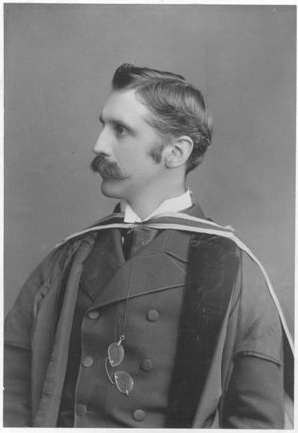 Samuel Henry Butcher (April 16, 1850 – December 29, 1910) was an Anglo-Irish classical scholar, academic administrator, and politician. Best known for his co-translation of
Homer’s Odyssey into prose with Andrew Lang, Butcher was a dominant figure in late-Victorian and Edwardian classics.
Samuel Henry Butcher (April 16, 1850 – December 29, 1910) was an Anglo-Irish classical scholar, academic administrator, and politician. Best known for his co-translation of
Homer’s Odyssey into prose with Andrew Lang, Butcher was a dominant figure in late-Victorian and Edwardian classics.
Born in Dublin to Samuel Butcher (Bishop of Meath) and Mary Leahy. His younger brother was
John Butcher, 1st Baron Danesfort and his sister was Fanny Prothero, one of the founding members of the Ladies Dining Society. He was educated at Marlborough College before attending Trinity College, Cambridge.
At Trinity, he had a stellar undergraduate career, graduating as Senior Classic and Chancellor's Classical Medallist in 1873. He was elected a Fellow of Trinity in
1874.
In 1876, he moved to University College, Oxford, as a fellow and tutor. In 1882, he was appointed Professor of Greek at the University of Edinburgh, a post he held for 21
years.
Butcher served as President of the British Academy (1909–1910) and represented Cambridge University in the British Parliament as a Member of Parliament (MP) from 1906
until his death in 1910.
During his undergraduate years at Trinity College, Butcher was elected to the Cambridge Apostles, an elite, highly
secretive intellectual club founded in 1820.
As an "Apostle" (and later an "Angel," as non-undergraduate alumni were known), Butcher engaged in weekly off-the-record discussions on philosophy, ethics, art, and
politics.
The Apostles of Butcher’s era were defined by rigorous philosophical debate, free enquiry, and deep personal loyalty among members. He maintained connections with fellow
Apostles throughout his lifetime, attending occasional dinners and events alongside figures like Henry Jackson and Sir
Frederick Pollock.
Understanding Butcher's connection to LGBTQ history requires placing him within the context of late 19th-century Cambridge academic life and the culture of the
Apostles.
In 1876, Butcher married Rose Julia Trench (daughter of the Archbishop of Dublin). Under Trinity College's celibacy rules for fellows at the time, getting married
required him to resign his Cambridge fellowship (though he immediately secured a fellowship at Oxford). Their marriage lasted until Rose's death in 1902; they had no
children.
While Butcher himself led a conventional public and marital life, the Cambridge Apostles were a central hub in the history of British queer identity:
The Apostles placed a premium on intense, emotional male friendships, heavily influenced by Plato's Symposium and classical Greek ideals of male mentorship and
affection.
Many Apostles in Butcher’s broader era—such as Oscar Browning,
Goldsworthy Lowes Dickinson, and later Bloomsbury figures like
Lytton Strachey and John Maynard Keynes—were openly or quietly romantic/sexual
with other men within these private intellectual circles.
As a prominent Greek scholar, Butcher’s work contributed to Victorian "Hellenism"—the academic re-examination of ancient Greek art, ethics, and poetry. In the Victorian
period, classical Greek literature served as one of the few acceptable domains where same-sex love and desire could be discussed and studied, making classicists like Butcher
central to the intellectual framing that early British queer thinkers drew upon.
References:
Other references:
- Oxford Dictionary of National Biography (ODNB): Entry for Samuel Henry Butcher (1850–1910), written by J. B. Bury (revised by M. C. Curthoys)
- Proceedings of the British Academy (1910): Memoir of Samuel Henry Butcher
- The Odyssey of Homer (1879, co-translated with Andrew Lang) by S. H. Butcher
- Aristotle’s Theory of Poetry and Fine Art (1895) by S. H. Butcher
- Some Aspects of the Greek Genius (1891) by S. H. Butcher
- Levy, Paul (1979). Moore: G.E. Moore and the Cambridge Apostles. Oxford University Press
- Deacon, Richard (1985). The Cambridge Apostles: A History of Cambridge University's Elite Intellectual Society. Cassell
- Winstanley, D. A. (1947). Later Victorian Cambridge. Cambridge University Press
- Cook, Matt (2003). London and the Culture of Homosexuality, 1885–1914. Cambridge University Press
- Taddeo, Julie Anne (2002). Lytton Strachey and the Search for Modern Sexual Identity. Routledge
Support this project
This website is a passion project researched, developed, and funded entirely by me. If you find the content valuable and would like to help support the ongoing research and hosting costs, any contribution is deeply appreciated.
Thank you for keeping this independent resource alive!
My books on Amazon: Elisa Rolle's books
BACK TO HOME PAGE

